Friday, July 15, 2016

Visualizing 19th-Century New York

A spatial interface to twenty essays on the objects and themes of the exhibit as well as the objects and landmarks.  
Nineteenth-century New York City was a visual experience, a spectacle for residents and visitors alike. Visions of Broadway dominated the burgeoning number of visual images of New York that poured out of commercial publishing firms and entered American homes during the nineteenth century.
More at Visualizing 19th-Century New York, Framing the City: Civic Landscape and Identity, and other essays

Wednesday, February 17, 2016

Fear the everyday state

On the fifth anniversary of the fall of Egypt's president Mubarak, this is an account of the uprising, and the ebb and flow of the Egyptian revolution, from an anonymous activist in Cairo.

Protesters against Mohammed Morsi in Tahrir square

Protesters against Mohammed Morsi in Tahrir Square


Continue reading Fear the everyday state online and be overwhelmed as you read -- or download Fear the every day state_1.pdf  (148.16 KB) and be overwhelmed when you read it later. Weep. 


Remember "this beast has colonialism as its ancestor." Try to breathe. 

Sunday, August 24, 2014

Florilegium urbanum

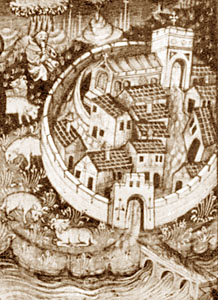
townMedieval English urban history - Introduction


The vast majority of the primary sources that bear witness to medieval English towns and the lives of the men and women who resided in them each focus on some particular aspect or event. General descriptions of any individual towns are rare, as are surveys or reviews of English towns generally. We do possess a few examples of these, however, and several are given here. Two happen to be roughly contemporary with each other, from the period when we are just beginning to see boroughs emerging as distinctive entities in the social and economic fabric. Furthermore, they present contrasting viewpoints on urban society: one pro, one con. The third comes at the close of the Middle Ages, while the fourth is a century later yet looks back at a city as it was in the medieval period. A fifth document (actually the fourth in the sequence below) is not in the same mould, but has been included for the light it throws upon key characteristics of towns in medieval England.


Most of the medieval texts presented in the Florilegium Urbanum almost inevitably date from the thirteenth to fifteenth centuries – the final third of what is conventionally considered the European Middle Ages. This is due to a dearth of surviving written documentation produced by urban sources in earlier periods.

Saturday, July 12, 2014

.@airplanereader on writing about place

…saturated with memories, associations, tracks and traces, more layers than a medieval palimpsest, unstable boundaries…I took pains excavating those layers in Little Dorrit (dss chapter) but don't manage so well writing about my own personal places, falling back on images, links to the efforts of others…this blog…

It's impossible to write about place.
I was chatting with my friend Ian the other day and he mentioned in passing, "writing is impossible." We had been talking about how hard it really is to write clear coherent prose. It is. Difficult, I mean. Just try following your thoughts and sensations for five minutes, and putting them into neat prose.
Then you add a topic, or god forbid a 'theme', and it gets harder still. Focus, attention, word by word, sentence to paragraph. Logical propositions. What was I talking about again?


It's impossible to write about place.
 Read the rest at What is literature?: Writing about place

Wednesday, July 9, 2014

the view from Latin America

 A new issue of Critical Reviews of Latin American Research is out. Jose H. Bortoluci and Robert S. Jansen (Michigan): "Toward a Postcolonial Sociology: The View From Latin America." Erin Graff Zivin (USC): "Beyond Inquisitional Logic, or, Toward an An-archaeological Latin Americanism."


Matiias Bargsted, Juan Carlos Castillo, and Nicolas M. Somma (UC-CL): "Political Trust in Latin America." Naomi Roht-Arriaza (Hastings): "After Amnesties Are Gone: Latin American National Courts and the New Contours of the Fight Against Impunity." Roberto Laver (Harvard): "Judicial Independence in Latin America and the (Conflicting) Influence of Cultural Norms."


Juan Cristaldo and Lorena Silvero (UNA): "Maps of Our Shared Territory." Tanya Golash-Boza (UC-Merced) and Eduardo Bonilla-Silva (Duke):"Rethinking Race, Racism, Identity and Ideology in Latin America." From the International Journal of Multicultural Education, a special issue on Globalization and Educational Equity in Latin America


and much more at the view from latin america - bookforum.com / omnivore

Monday, April 7, 2014

#Urban Sprawl: Get Fat, Stay Poor…Die In Car Crashes

…or enervated by the monotony of boring repetition…death by simulacra? But what about inner city poverty, food deserts, or is this vision meant primarily for the upwardly mobile and ambitious?


❝That urban design improves the quality of people’s lives is an old idea. A new study, Measuring Sprawl 2014, now finds that people who live in densely populated regions benefit in many ways. In brief, they have greater economic mobility, they're healthier, and they live longer❞


Urban Sprawl: Get Fat, Stay Poor, And Die In Car Crashes | Co.Design | business design

Sunday, January 19, 2014

#city & other getaways

…#CityMOOC fodder from the mbx works on multiple levels: place, city, even #rhizo14although that could take some 'splainin to connect. Pinterest's label,"ideas for a long weekend getaway" is not even on the list since I hardly ever "get away" unless I can do virtually -- and that is just about every day, 

Rhizomatic connects here because a) it describes my social media network explorations, b) the interests they connect, and c) may (as Michael Melcher said about the metaphor) be another, better organizing metaphor for both networks and cities. Searching "rhizome +city" turns up intriguing results like the Urban Rhizome or the Rhizome Collective -- others too. Going on 15 years after, and I'm still collecting spatial metaphors to "organize" (ha!) and imagine/visualize cityspace: rhizome joins — consolidates — palimpsest and labyrinth, but counters quincunx (perhaps as anti- or un- in a Greimas schematic)

Pinterest
City escape boards to follow

Wednesday, January 8, 2014

In LaPlace LA 203 years ago today

…among other things not taught in 8th grade Louisiana history back in the 50s

Revolt…The largest slave revolt in United States history occurred on this date 203 years ago. The uprising started in what is now LaPlace in St. John the Baptist Parish in 1811 and rolled eastward, with a goal of reaching New Orleans and possibly banding with other rebels to take the city.

Read the rest of The largest slave revolt in U.S. history occurred this day 203 years ago. It started in LaPlace

Art by renowned River Parishes artist Lorraine Gendron depicts the largest slave revolt in United States history. It started in LaPlace and rolled east toward New Orleans before being crushed in Kenner.

Friday, September 6, 2013

Poor Placemaking in 5 Easy Steps

…cautionary tales #citymooc, planners, wannabe placemakers &altria…late night speedblogging made easy via inbox & newsletters…never mind, still good reads
Top stories from Sustainable #Cities Collective on September 6, 2013
Sustainable Cities Collective sponsored by
Siemens
Most read on Sustainable Cities Collective
» Subscribe to our daily post digest email!
Editor's Choices
By Jim Russell - The latest exodus from the Emerald Isle has reached hyperbolic speed. Ireland's rate of emigration is continuing to increase and at one stage one person was leaving the country to live abroad every six minutes - the highest number since modern records began in the late 1980s.  » Continue...
By This Big City - Osaka is flat, well-signposted, and chock full of destinations to whizz around at high-speed. It's also relatively cycle-friendly, something that will come as a bit of a culture shock to British and American tourists used to navigating roads stuffed with particularly homicidal drivers.  » Continue...
By The Dirt ASLA - With the success of High Line Park in New York, every city is looking at their old railroad tracks as untapped assets instead of eyesores ready for the scrap heap. Queens seeks to turn a stretch of abandoned Long Island track into a foundation for a new park called the QueensWay.  » Continue...
By Katrina Johnston-Zimmerman - Walking the streets of any city one can find a myriad of terrible places simply because of the design itself. And make no mistake, they are designed, they're just designed poorly. When discussing urban design, thankfully, the tone increasingly is that of good design.  » Continue...
By Hassan Arif - The 50th anniversary of Martin Luther King's "I have a dream" speech and the march on Washington for social justice sheds light on Dr. King's mission, on the progress that has been made since his 1963 speech and on the long way still to go.  » Continue...
By Global Site Plans - The Grid - After months of community outreach, a public design forum and study of area traffic, a pilot project in downtown Oakland implements an alternative use of public space that could have a permanent effect on local businesses, downtown circulation and neighborhood vibrancy.  » Continue...

Stay connected...

Twitter RSS
feed Facebook
 Poor Placemaking in Five Easy Steps

Saturday, August 17, 2013

Other worlds are possible

sf-illo
…according to science fiction authors roundtable. Interviewer Leigh Phillips joins authors Gwyneth Jones, Marge Piercy, Ken MacLeod and Kim Stanley Robinson to discuss the role of science fiction in extending the radical horizons of our imaginations


Other worlds are possible: science fiction authors roundtable | Red Pepper

Thursday, June 27, 2013

Travel…learning through motion, intention & serendipity

…Sean Michael is a favorite blogger, mooc-met and sharing an interest in citylit, representations of city spaces ~ real, imagined, visual, written ~ whom I do not visit often enough.
Today’s post is about travel, motion, and all that, and how learning and understanding emerge from both experience and structured thought. There are some quotes scattered throughout that relate to travel from writers who have articulated their thoughts on travel well. 

Our battered suitcases were piled on the sidewalk again; we had longer ways to go. But no matter, the road is life. – Jack Kerouac
Before launching into this, I wanted to briefly say that travel is different for everyone, yet it holds such a grip on our collective imagination. It is everyone’s ‘dream’ even when it really isn’t. I know people that find travel to be more fatiguing than enriching, more hassle than its worth. As a society, we should be alright with this. It needn’t be everyone’s dream, but knowing the journey from the destination (and the importance of the former over the latter) should be an organizing philosophy for all. 
Travel and emergence: learning through motion, intention, and serendipity | Michael Sean Gallagher

Peep at These Fantastic Vintage #City Panoramas

…including #ABQ in 1915perfect for a #City MOOC project on American cities, urban history, visual representations or historical images of the city…just plain fun to look at too. The G+ community does not seem to be doing much planning, just throwing down links, playing the dozens with URLs. 

Haines Photo Co., 1915, "Panorama of Albuquerque, N. Mex.,"
courtesy Library of Congress (PAN US GEOG - New Mexico no. 2).
Britain's Daily Mail introduces us to a fantastic digital archive of vintage city panoramas housed at the Library of Congress. About a quarter of the roughly four thousand images in the collection are devoted to cityscapes — incredibly wide sweeps of downtown areas trapped in time circa one hundred years ago. Good luck getting anything done this next hour
Peep at These Fantastic Vintage City Panoramas - Eric Jaffe - The Atlantic Cities

Friday, June 21, 2013

Sustainable #Cities Collective Weekly…#CityMOOC reading

…too pedestrian for flânerie fodder. Plus, place along the way is a blog looking for a place in the network. Space, places, kinds of space and place making might suit…and of course the City MOOC

Sustainable Cities Collective newsletter
Top stories from Sustainable Cities Collective on June 21, 2013
Sustainable Cities Collective sponsored by Siemens
Most read on Sustainable Cities Collective

Monday, June 3, 2013

Heterotopia in Istanbul

…#cityspace, something for the #citymooc, a supplement & companion piece or exemplum to Foucault's essay, Of Other Spaces (1967), one of many…spaces in Borges, Eco, Calvino. It illustrates Foucault's "oppositions that we regard as simple givens: for example between private space and public space, between family space and social space, between cultural space and useful space…"


image-1The protests and occupations in Istanbul and other cities in Turkey began with but have now expanded far beyond the initial gathering in Taksim Gezi Park.
A Turkish colleague has been closely following these events and offers some useful links and insights:
In the second article, there are also useful links to find out about the kinds of demolishings, displacements, and dispossessions caused by the top-down urban transformation projects forcefully implemented since the mid-2000s. 
Heterotopia in Istanbul | occasional links & commentary

Friday, May 3, 2013

a secret New York subway station

CIty Hall, the secret New York subway station

…We don’t know how, but somehow, somewhere in New York’s subway system, a secret City Hall subway station lurks. With its tall ceilings and brass fixtures, it looks positively majestic and grand. The station has been closed to the public since 1945 as it was deemed too unsafe for use, but apparently, commuters in the know can see the station without getting off on the 6 Train.

NY Subway (6) NY Subway (8) NY Subway (7) NY Subway (5)


The post City Hall, the secret New York subway station appeared first on Lost At E Minor: For creative people.

Monday, April 15, 2013

Spain’s “Move Your Money!” Campaign Advocates for Ethical Banking

The "Move your money!" logo. Taken from its <a href="http://remuevetudinero.net">homepage</a>.…from the splendid Global Voices. Open a window on the world and cultivate a global perspective by following it if you are not already. 

PS great other language reading practice too when you
Various organizations have joined together to launch the “Move your money!“ [es] initiative in Spain, aiming to convince citizens to transition from traditional banks, which are in large part responsible for the current economic crisis, to emerging financial institutions commonly called “ethical banks.”
Read the rest of Spain’s “Move Your Money!” Campaign Advocates for Ethical Banking ~ Global Voices

Thursday, April 11, 2013

Edinburgh literature festival that could change history

Heart of Midlothian
Heart of Midlothian, title of a Sir Walter Scott historical
novel and  symbol for Edinburgh football team, Hearts
…books are places along the way too…either place in books OR places and books are doubly so…

The first festival of historical fiction could mean that the 'problematic' historical novel will soon be a thing of the past. The genre-defying historical novel can come in the form of a crime novel, a romance, a political thriller, a biography or a literary novel.

This weekend, the Summerhall arts venue in Edinburgh is hosting the first ever literary festival devoted to historical fiction. It's the brainchild of Iain Gale, the art critic and author of several works of military historical fiction in the vein of Bernard Cornwell and Patrick O'Brien, and Allan Massie....


The "historical novel" isn't really a genre – since every genre can be made historical. Steampunk is really just historical SF; and Adam Roberts has written superb works, such as Yellow Blue Tibia, featuring science fiction tropes in a historical setting. And steampunk begat flintlock fantasy: I'm rather fond of Naomi Novik's Temeraire series (Napoleonic sagas with dragons). Kim Newman's Anno Dracula series gives us historical horror. I have so far been unable, much to my chagrin, to obtain a copy of Peter H Cannon's 1994 intersection of PG Wodehouse and HP Lovecraft, Scream for Jeeves.

Even within literary fiction, the idea of the "historical novel" is problematic.
The Edinburgh literature festival that could change history | Stuart Kelly | Books | The Guardian

Thursday, March 21, 2013

latin america's economic spotlight

reposted from Book Forum's blog, Omivore, best & truly eclectic collections of briefly annotated links on the tubz…politics, religion, science, education, culture, literature, arts & more...for the omnivorous reader


Nancy Birdsall (CGD): A Note on the Middle Class in Latin America. Nora Lustig (Tulane), Luis Felipe Lopez-Calva (Colegio de Mexico), and Eduardo Ortiz-Juarez (UNDP): Declining Inequality in Latin America in the 2000s: The Cases of Argentina, Brazil, and Mexico. Esteban Perez Caldentey, Daniel A. Titelman, and Pablo Carvallo (ECLAC): Weak Expansions: A Distinctive Feature of the Business Cycle in Latin America and the Caribbean. The magic number: South America's experience suggests a tantalizing possibility — that reaching $8,500 in income is the secret to sustainable growth. Think there's no alternative? Latin America has a few. Why is Mexico concerned about Latin America's economic spotlight shifting to Brazil? Colombian elites are celebrating economic and security gains, but not everyone is benefiting — just ask the Afro-Colombian minority.

latin america's economic spotlight - bookforum.com / omnivore

Friday, February 15, 2013

How Manhattan Got Its Street Grid

Measure of Manhattan, John Randel, Jr
Cartographer, Surveyor, Inventor
To accommodate a fast-growing New York City, John Randel, Jr., began to lay out the city’s streets in 1808—an impressive endeavor that holds lessons for today’s information infrastructure.

A few years ago, researchers began looking for the earliest evidence of Manhattan’s iconic grid plan, which places streets and avenues along mostly horizontal and vertical directions (in contrast to the spoke-and-wheel layouts of cities such as London or Paris). In particular, they were hunting long-lost surveying marks left by a complicated young man named John Randel, Jr., whose maps helped establish the shape of New York City. The following excerpt (link below) is adapted from the book, The Measure of Manhattan: The Tumultuous Career and Surprising Legacy of John Randel, Jr., Cartographer, Surveyor, Inventor, by Marguerite Holloway (W. W. Norton, 2013). Copyright © Marguerite Holloway.


How Manhattan Got Its Street Grid [Excerpt]: Scientific American

Thursday, January 10, 2013

A Prefab House Based On A Client’s Fond Memories Of Past Homes


“We tried to incorporate and promote the clients memories, desires, experiences, and fictions in the design process,” explain the architects at Spanish studio elii.

My earliest memories--and yours, I’d wager--are of spaces: kitchen windows, dining-room tables, and snowy backyards. Place and memory are closely tied in our densely packed brains, hence all of the recent fraternizing between neuroscientists and architects.

So space affects memory. But could memory also affect space? That was the question for elii, a Spanish architecture office that accepted an unusual commission for a home several years ago. Their client requested that the architects design her new home--on the outskirts of Madrid--based on happy memories.

Did A Prefab House Based On A Client’s Fond Memories Of Past Homes intrigue you? Now Read Full Story